Mittens vs gloves: when to choose mittens
- Mittens keep the fingers together, so they share their warmth. Gloves separate them and give more dexterity.
- Choose mittens for cold days with steady work or long hours outside: firewood, snow, winter walks.
- Choose gloves when you need your fingers: knots, zips, small tools, a camera.
- A warm mitten depends on its insulation, its shell and its closure at the wrist.
- Size is measured around the palm of your dominant hand, without the thumb.
A glove is made for the hand. A mitten is made for the cold.
Seven in the morning, the car covered in snow, the shovel by the door. You pull on your gloves, and ten minutes later the tips of your fingers have gone quiet. The same morning in a pair of mittens usually ends differently.
This guide looks at mittens vs gloves in practical terms: why one is warmer, when each makes sense, what to look for in a pair of winter mittens and how to look after leather ones. It is based on the mittens and gloves we make, wear and finish ourselves.
Mittens vs gloves: what is the difference?
The difference is one seam line. A glove gives every finger its own sleeve. A mitten keeps four fingers in one compartment and gives the thumb its own.
That single choice changes almost everything else: how warm the hand stays, how much you can feel through the leather, and which jobs you can do without taking it off.
Are mittens warmer than gloves?
Generally, yes. In a mitten, your fingers lie against each other and warm each other. In a glove, each finger is wrapped on all sides by cold material, and more surface is exposed to the air.
That is why medical advice on staying warm, such as guidance on preventing hypothermia, often recommends mittens rather than gloves.
A mitten is still only as warm as what it is made of. A thin, unlined mitten will lose to a well-insulated glove. And a damp mitten loses heat quickly, whatever its shape.
When to choose mittens
Mittens make the most sense when the cold is the main problem and fine movements are not.
Steady work in the cold
Carrying firewood from the shed. Clearing the path after a night of snow. Breaking ice on the water butt. These jobs need grip and warmth more than they need feeling in each fingertip.
A leather mitten closes around a log or a shovel handle just as well as a glove, and the fingers stay warmer while they do it.
Long hours with little movement
Your hands get colder when you stand still: watching a fire, waiting for the dog on a long winter walk, sitting on a frozen lake. Warm mittens hold their heat better through those slow hours.
Hands that get cold easily
Some people have cold fingers long before the rest of the body feels it. For them, the question of mittens or gloves is often settled by October.
When gloves are the better choice
Gloves win as soon as the work becomes precise.
- Knots and buckles. Tying a guy line, closing a pack, adjusting a strap.
- Small tools and fastenings. A knife, a lighter, a zip, a carabiner.
- A camera or a phone. Anything with small buttons.
- Milder days. When it is cool rather than cold, a mitten can be more than you need.
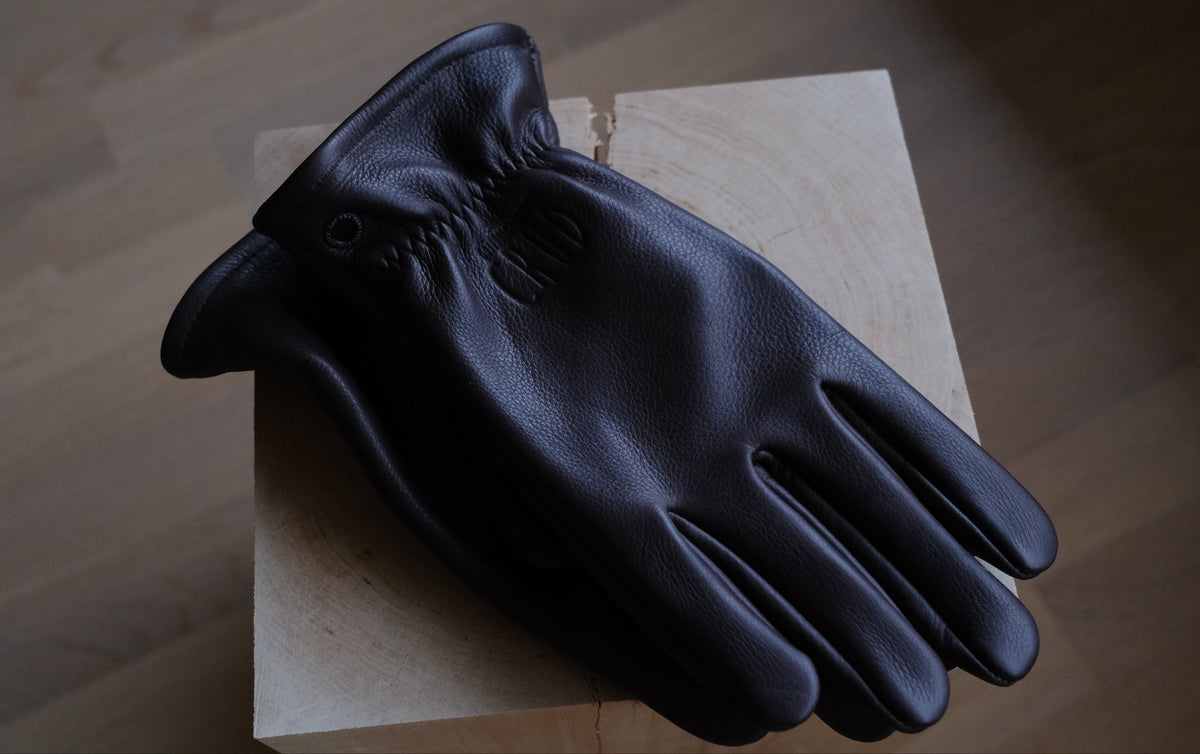
For cold weather, our Mitsuhiko gloves 2.0 have a removable wool blend liner, so you can wear them lined on cold days and as a shell on milder ones. For fire and heavier work in cooler weather, the unlined Gjöra gloves sit closer to the hand.
Many people end up with both: mittens in the pocket of the winter coat, gloves on the hook by the door.
What makes good winter mittens
Shape decides the principle. Construction decides how the mittens hold up after many winters.
Insulation that does not get in the way
Our leather mittens are lined with 100 g Thinsulate™. It insulates without unnecessary bulk, which matters when you need to hold a shovel or a log rather than just keep your hands in your pockets.
A shell that takes the wear
The outer layer is full-grain cowhide, the part of the hide where the fibres are tightest. It is firm at first. After a couple of uses it softens and takes the shape of your hands.
Full grain also keeps a record. A darker palm, a scuff from the woodpile, a softer crease at the thumb are signs of use, not defects.
Seams placed away from the wear
The Mitsuhiko mittens have a full welt wing thumb, a construction with no exposed seams where your grip wears hardest. The seams are sewn with Kevlar® thread.
A closure at the wrist
Cold air finds its way in at the cuff. A bright orange paracord drawstring with a locking eyelet closes the mittens snugly around the wrist. All the hardware is brass.
A finish against wet snow
The yellow pair is finished by hand in our atelier in Onsala. A blend of natural waxes and oils is worked into the leather in several steps, which gives a water-repellent surface and a faint scent of Nordic pine. Because it is done by hand, the colour varies slightly from pair to pair.
Water-repellent means snow and rain bead off the surface. It does not mean the mittens are made to be submerged.
Mitsuhiko mittens, yellow
Full-grain cowhide, 100 g Thinsulate™, wax finish applied by hand.
Sizes S to XLCold daysMitsuhiko mittens, black
Full-grain cowhide, 100 g Thinsulate™, Kevlar® thread.
Sizes S to XLCold and precise workMitsuhiko gloves 2.0
Full-grain goatskin, removable wool blend liner knitted in Japan.
Medium cuffFire and handworkGjöra gloves
Full-grain Pittards cowhide, wax finish applied by hand in Sweden, unlined.
Short cuffCareCrud leather wax
Local beeswax with natural fats and oils, for leather mittens and gloves.
30 ml or 100 mlFinding the right size
A mitten that is too tight presses the insulation flat and lets the cold through. One that is too loose makes it harder to grip.
Measure around the palm of your dominant hand, just below the knuckles and without the thumb. Compare the measurement with the size chart on the product page.
If you are between two sizes, choose the larger one. The leather feels firm when new and settles to your hand once worn a couple of times.
Caring for leather mittens
Leather mittens ask for little, but they do ask.
- Brush off snow before you go inside. Snow that melts on the leather soaks in; snow brushed off does not.
- Dry them slowly. At room temperature, away from radiators, stoves and open flames. Direct heat dries the leather too fast and leaves it stiff.
- Wax them when they look dry. Work a thin layer of Crud leather wax into the leather by hand and let it soak in. A little goes a long way, and the leather may darken slightly.
- Use them. Gripping and bending is what breaks the leather in.
More on looking after leather is on our product care page.
Where our mittens are made
Glove making require specialised machines and skills that are no longer widely found in Sweden. The Mitsuhiko mittens are cut and sewn by experienced glove makers in the USA. The yellow pair then comes to us for its wax finish. You can read more about how our gloves are made.
Every pair is covered by our lifetime warranty for the original owner against defects in materials and manufacturing. If something wears out beyond the warranty, we repair it at a reasonable cost whenever possible. More on our warranty and repairs page.
Made in Sweden, made to last
Crud is a small Swedish brand founded by Alex Bechet after more than ten years in the fashion industry, driven by a long interest in the outdoors.
We design and make bags, backpacks and leather accessories in Sweden, in small batches, from 18 oz waxed canvas and vegetable-tanned leather from Tärnsjö Garveri.
Our gloves and mittens are made with skilled partners abroad and, depending on the model, finished in our workshop in Sweden.
We would rather make one thing that lasts than several that do not.
Mittens vs gloves: choosing for the cold
The question of mittens vs gloves rarely has one answer for the whole winter.
The mittens that come out when the thermometer drops. The pair that has carried every armful of wood since November. The gloves you swap to when the knot on the tarp needs undoing. The yellow leather that has gone a shade darker at the palm.
Choose mittens for the cold, gloves for the detail. Measure your hand. Dry them slowly.
Then let the winters do the rest.
You will find our leather mittens in the mittens collection and every other pair in our gloves collection.
Frequently asked questions about mittens and gloves
Are mittens warmer than gloves?
Generally, yes. In a mitten, the fingers lie together and share their warmth, while a glove separates them and exposes more surface to the cold. A mitten is still only as warm as its insulation, and it loses heat quickly if it gets damp.
When should you wear mittens instead of gloves?
Wear mittens when the cold is the main concern: steady outdoor work such as carrying firewood or clearing snow, long periods with little movement, or if your fingers get cold easily. Wear gloves when you need dexterity for knots, zips, small tools or a camera.
Can you work in mittens?
Yes, for work that needs grip rather than fine finger movements. Leather mittens close well around a shovel handle, a log or a tool handle. For precise tasks, many people take the mittens off for a moment or switch to gloves.
How should leather mittens fit?
Measure around the palm of your dominant hand, just below the knuckles and without the thumb, and compare it with the size chart on the product page. If you are between two sizes, choose the larger one. New leather feels firm and settles to the hand after a couple of uses.
How do you dry and care for leather mittens?
Brush off snow, then let the mittens dry slowly at room temperature, away from radiators, stoves and open flames. When the leather looks or feels dry, work in a thin layer of leather wax by hand and let it soak in.

Written by Oliver Lauterwein