Artikel: Så väljer du arbetshandskar i läder
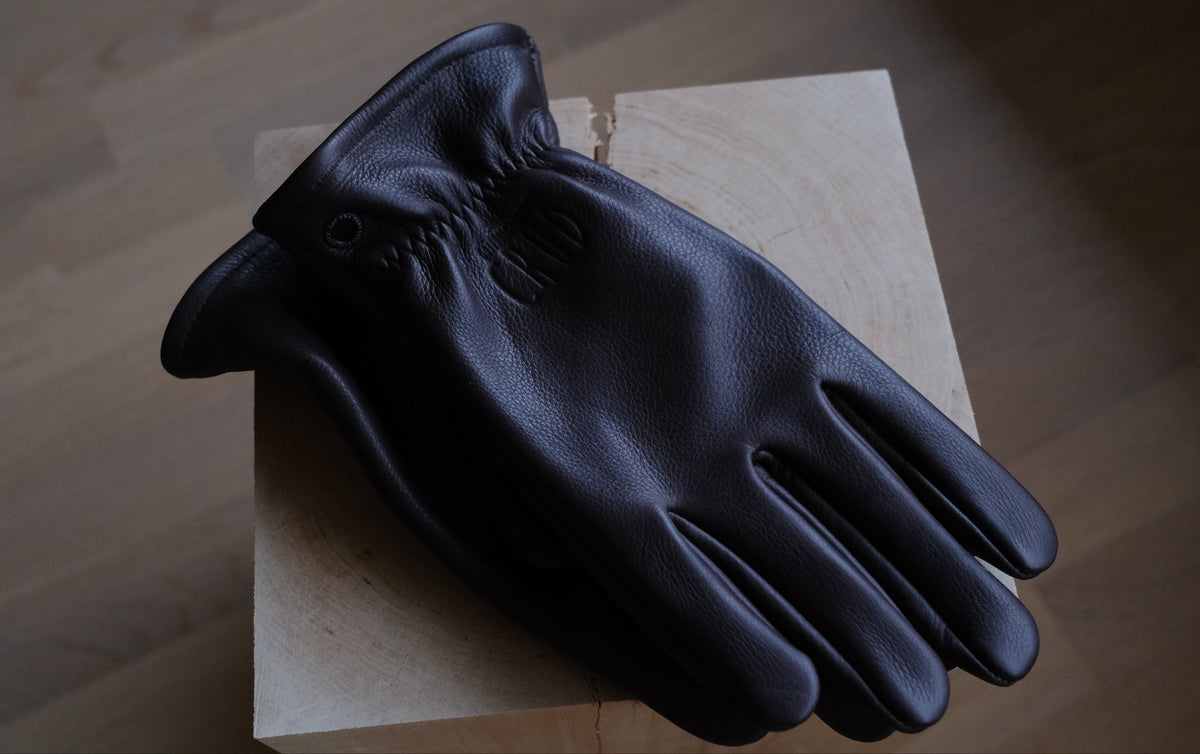
Så väljer du arbetshandskar i läder
- Choose leather work gloves for the job they will do: fire, firewood, sharp material, cold or fine handwork.
- The leather sets the character of the glove. Cowhide is dense and protective, goatskin is soft and close-fitting, elk skin is thick and flexible, bison is made for thorns and wire.
- Cuff length, seam placement, thread and lining decide where the glove protects you and how long it holds together.
- Size is measured around the dominant hand. Each model has its own size chart.
- Leather gloves feel stiff at first and take the shape of the hand with wear.
Most gloves are chosen by size and colour. Work gloves are better chosen by what they will be holding.
A split log with a rough edge. The handle of a pot that has been sitting on the embers. A roll of barbed wire on a fence line. A frozen carabiner on a January morning. Each of these asks something different of the leather on your hands.
This guide explains how to choose leather work gloves step by step: the type of leather, the cuff, the seams, the lining, the fit and the care. It is based on the gloves we make and finish ourselves, and on what we have learned from wearing them.
Start with the work, not the glove
Before comparing models, describe the job in one sentence. The answer usually points to two or three features that matter, and several that do not.
- Fire and camp cooking. Look for dense leather and a longer cuff that covers the wrist.
- Firewood, tools and rough handling. Look for reinforced palms and fingertips and strong thread.
- Sharp objects and cutting risks. Look for a cut-resistant lining, not just thick leather.
- Cold weather. Look for a lining, ideally one you can take out.
- Handwork that needs feeling in the fingers. Look for soft goatskin and pre-bent fingers.
A glove that tries to do all five will usually do none of them particularly well. It is often simpler to own two pairs: one for heat and heavy work, one for dexterity.
Which leather for work gloves?
The hide decides how the glove protects, how it feels on the first day and how it changes after many days.
Most of our gloves are made from full-grain leather. Full grain keeps the outer surface of the hide intact, where the fibres are tightest. It is also the surface that darkens and records how the glove has been used.
Cowhide: dense and protective
Cowhide is the classic material for leather work gloves. Its tight grain gives natural abrasion resistance and good protection against heat.
The Gjöra gloves are made from full-grain cowhide from Pittards, a British leather maker whose history goes back to 1826 and to the glove makers of Yeovil in Somerset (Pittards heritage). The Molg gloves and the Dickson gloves are also full-grain cowhide, made in the USA.
Goatskin: soft and close to the hand
Goatskin is softer and more supple than cowhide while staying durable. It suits work where you need to feel what you are holding: knots, small tools, the zip of a pack.
The Vuogas gloves and the Mitsuhiko gloves 2.0 are full-grain goatskin. The Vuogas gloves have pre-bent fingers, and the Mitsuhiko gloves 2.0 have slightly wider fingers for better dexterity.
Elk skin: thick but flexible
The Gjöra Elk Skin gloves are soft, thick and slightly more flexible than our regular Gjöra gloves. They are made in the USA and have a longer cuff, which makes them a good choice around the campfire.
Bison: for thorns and wire
Bison hide has densely packed fibres that resist wear. The Gjöra Bison gloves are made in the USA from mahogany brown American bison leather, for work with thorns, barbed wire and other sharp objects that could pierce softer leather.
They need more breaking in than the others. That is the price of the protection.
Heavy duty leather work gloves: details that decide how long they last
Two gloves can be cut from the same leather and wear out at very different speeds. The difference is in the construction.
Seams
Seams are where most gloves fail first. There are two ways to protect them.
The first is to move them to the outside. The Molg, Vuogas and Kengis gloves and the Mitsuhiko gloves 2.0 have exterior seams. The inside of the glove stays smooth, with no ridges against the fingers.
The second is a full welt wing thumb, as on the Gjöra, Bison and Dickson gloves. The thumb is cut so that there are no exposed seams at the point that takes the most friction.
Thread and reinforcement
The Molg, Vuogas, Kengis and Dickson gloves are sewn with Kevlar® thread, which is known for its strength and resistance to wear.
On the Vuogas gloves, the palm and fingertips have an extra layer of leather. Each fingertip has double seams and a small leather tab that rolls over the seam to protect it. The Mitsuhiko gloves 2.0 have seam protectors on every fingertip.
Cuff length
The cuff is easy to overlook and important near a fire.
- Short cuff: Gjöra, Molg and Dickson. Easy to pull on and off, good for general work.
- Medium cuff: Vuogas, Kengis and Mitsuhiko 2.0. A little more cover at the wrist.
- Long cuff: Gjöra Elk Skin and Gjöra Bison. Designed to shield the hands and wrists from fire and abrasive objects.
Lined or unlined leather work gloves
Most of our gloves are unlined. Unlined leather sits closer to the hand, moulds to it faster and dries more easily.
A lining adds a function the leather alone cannot provide.
- Cut resistance. The Dickson gloves are lined with Kevlar® for cutting and abrasion resistance when handling sharp objects.
- Warmth. The Mitsuhiko gloves 2.0 have a removable liner knitted in Japan from fine wool fibres blended with recycled polyester. Take it out on milder days and wear the shell alone.
If you are looking for insulated leather work gloves for winter, a removable liner is the more flexible option: one pair covers more of the year.
Water, wax and the smell of pine
Leather and wet weather need a little help to get along.
When the Gjöra gloves reach our workshop in Sweden, we work a traditional blend of natural waxes, fats and oils into the leather in several stages. The Molg, Dickson and Gjöra Elk Skin gloves receive the same hand-finishing treatment.
The result is a water-repellent surface and a scent of Nordic pine. Because the process is done by hand, each pair varies slightly in colour and texture.
Water-repellent means that the surface sheds rain and snow. It does not mean the gloves are made to be submerged.
Gjöra gloves
Full-grain Pittards cowhide, wax finish applied by hand in Sweden, unlined.
Short cuff Everyday workMolg gloves
Full-grain cowhide, exterior seams, Kevlar® thread.
Short cuff Rough workVuogas gloves
Full-grain goatskin, reinforced palm and fingertips, Kevlar® thread.
Medium cuff Sharp objectsDickson gloves
Full-grain cowhide, Kevlar® lining, full welt wing thumb.
Short cuff Thorns and wireGjöra Bison gloves
American bison leather, no exposed seams, unlined.
Long cuff Cold weatherMitsuhiko gloves 2.0
Full-grain goatskin, removable wool blend liner, elastic wristband.
Medium cuffHow to find the right size
A work glove that is too big folds in the palm and loses grip. One that is too small tires the fingers and strains the seams.
Use a measuring tape to measure the circumference of your dominant hand. Compare the result with the size chart on the page of the glove you are considering: the charts differ between models.
New leather gloves can feel tight at first. They stretch a little and settle to the hand once they have been worn a few times. For the Vuogas gloves, choose the larger size if you are between two.
Breaking in and looking after your gloves
Waxed leather gloves feel slightly stiff on the first day. With wear they soften and take the shape of your hands, which is why a pair you have used for a while fits better than a new one.
A few habits help them along:
- Wear them for real work early on. Gripping, carrying and bending the fingers is what breaks the leather in.
- Brush off dirt once it is dry. Then wipe with a damp cloth if needed.
- Let wet gloves dry slowly. At room temperature, away from the stove or a radiator.
- Wax them when the leather looks dry. Work a small amount of Crud leather wax into the leather with a rag. The wax was first developed for our Gjöra and Molg gloves. The leather may darken slightly afterwards.
- Keep the marks. Darker fingertips, scorch marks and a palm polished by an axe handle come from use. They are not defects.
More on caring for leather is on our product care page.
Where our gloves are made
We make our bags, backpacks and leather accessories in Sweden. Our gloves are a different story, and we prefer to be open about where different parts of the work take place.
Glove making as a trade has largely disappeared from Sweden, along with the machines and the specialised knowledge of glove leather. We work with glove makers in the USA, Ethiopia and Japan, chosen for their craftsmanship. Some models, such as the Gjöra gloves, are then finished by hand in our workshop in Sweden.
You can read more on our page about glove manufacturing.
Made in Sweden, made to last
Crud is a small Swedish brand founded by Alex Bechet after more than ten years in the fashion industry, driven by a long interest in the outdoors.
We design and make bags, backpacks and leather accessories in Sweden, in small batches, from 18 oz waxed canvas and vegetable-tanned leather from Tärnsjö Garveri.
Our gloves are made with skilled partners abroad and, depending on the model, finished in our workshop in Sweden.
We would rather make one thing that lasts than several that do not.
Choosing leather work gloves that will last
The leather work gloves you keep are rarely the ones with the longest list of features.
They are the gloves that hang by their eyelets from the keychain by the door. The pair that has gone dark at the fingertips from the fire. The goatskin gloves that know where your knuckles are. The long cuffs that have lifted the pot off the fire more times than you can count.
Name the job. Measure your hand. Choose the leather and the cuff for the work, not for the shelf.
Then let the work do the rest.
You will find every model in our gloves collection, and the leather wax and keychain among our accessories.
Frequently asked questions about leather work gloves
How do I choose leather work gloves?
Start with the job: fire, firewood, sharp material, cold or fine handwork. Then choose the leather (cowhide for protection, goatskin for dexterity, bison for thorns and wire), the cuff length and whether you need a lining. Finally, measure the circumference of your dominant hand and compare it with the size chart for that model.
Is goatskin or cowhide better for work gloves?
It depends on the work. Full-grain cowhide has a tight grain that gives natural abrasion resistance and good protection against heat. Goatskin is softer and more supple, which gives more feeling in the fingers for handwork.
How do I measure my hand for work gloves?
Measure the circumference of your dominant hand with a measuring tape and compare it with the size chart for the specific glove. The charts differ between models. Leather gloves can feel tight at first and stretch slightly once worn a few times.
How do you clean leather work gloves?
Brush off dirt once it is dry and wipe the leather with a damp cloth if needed. Let wet gloves dry slowly at room temperature, away from direct heat. When the leather starts to look and feel dry, work in a small amount of leather wax with a rag.
Are Crud gloves made in Sweden?
No. Depending on the model, our gloves are made in the USA, Ethiopia or Japan. Some models, such as the Gjöra gloves, are finished with a natural wax treatment in our workshop in Sweden. Our bags, backpacks and leather accessories are designed and made in Sweden.

Av Oliver Lauterwein